Wednesday, December 29, 2010

The Cat's Cradle

Got ice-nine?

I could have used some today. I was trying to get a three day irrigation project completed today, but the rain last night turned everything into a slurry.

Even the tracks on this baby were getting gummed up. I can see why the military in Kurt Vonnegut's novel wanted to find something to solidify the mud. If only it didn't freeze the oceans!

I tried trenching the cave-ins by hand, but the pea soup that used to be earth just stuck to the shovel and turned them into 50 lb weights on poles.

As if the hip deep mud weren't enough, I think it was the hail that finally caused me to call it a day. The rain was supposed to peter out by the afternoon. But it's after 2 and still raining sideways.

Sigh... Wish I didn't have anything to get DONE today!

Sunday, April 11, 2010

These last few weeks, Carmel Lavender has been working hard bringing more lavender to Carmel Valley.

Here in the photo is foreman Alfonso, Jose, Nick, Jay, Nico, Charlie, and Eliodoro standing in the new median field. In a couple of months the hundreds of plants will begin spiking lavender turning this avenue into a purple dream.

This field was prepped by ripping to a depth of 2 feet, which brought up a lot of the roots. And then disked. But each plant had to be hand placed. Drip irrigation lines were run down the rows subsequently. But lately irrigation has not been necessary. Mother nature has been taking care of that quite handily.

Hive Building Time

This weekend, I am building bee hives. More bees are coming in about a week. So I have to get their homes assembled and painted before they arrive. The weather is making this challenging however. This spring has been fairly wet for this area. That's great for the plants. But not so great if you have things to get done outside. For example building and painting bee hives.

So the first thing I did was try to make a covered area where I can work in a light rain. I got a cotton drop cloth. Cotton, not plastic. Cotton isn't waterproof, but hopefully will shed a light rain. Unfortunately those plastic tarps are an ecological disaster. They don't last forever. Then they start flaking into little pieces that wind up all over the planet. Nope. I'll try my luck with cotton. I hung this out behind my lavender workshop and leveled the area a bit. Then I set up two 2x6 rails on which to set the newly assembled hives for painting.

In the picture above, you can see me putting one of the hive super boxes together. They are already cut. I just need to glue the corners, and then put screws to hold them firm. Once they are all built, I stack them on the rails for painting along with the bottom boards, lids, and stands. Here I am enjoying my new outdoor hive workshop!

When I finish assembling, I paint! Unfortunately the sprinkling has started. Cold weather is not the best to paint in. But I suppose the show must go on. At this point, it is still cold enough I wish I could wait an extra week for things to warm up. Would be better for the bees too. Nice for them to have good weather when they start their new colony. Of course, the rain should mean there will be plenty of flowers for them to forage from when it does warm up.

Everything has it's benefits and nuisances. I guess there is something to be said for having a really big barn! Maybe someday.

Tuesday, March 9, 2010

Moving Day for Chicken

The wheat I planted in the fall is finally starting to look substantial. I wish it were a little thicker actually, but the chickens have been HUNGRY! I suppose with the cold air they need their calories. Well I have had the chicken tractor parked for a while waiting for the wheat to grow thicker. But I felt this week it was time to move, and let the chix graze on the new wheat grass.

If you are new to my blog and haven't read my previous stories about my chickens, let me provide a brief overview. My chickens live in a mobile chicken coop that you can see to the right on the far right of the photo. The coop protects them from the elements, and just as important, PREDATORS! However it is important for the hens to be able to get to the ground. To eat growing plants and bugs in the soil. So the purple beast to the left in the photo is the chicken tractor that attaches to the coop. These can be moved as the chickens eat their way through the ground beneath.

I move each part, the chicken tractor and the coop, separately. They are detached by removing the bridge tunnel. Then the chicken tractor is jacked up and the wheels deployed. The coop is just pulled. Both by tractor. Once they are moved and aligned, the bridge is reattached and the chickens let loose.

Here you can see the happy chickens foraging on the newly available grass. They absolutely LOVE fresh ground. They had so much fun eating the plants and rolling in the fresh earth. I came back about mid-day to find a dozen hens taking dirt baths in the fresh soil. They sure looked happy!

I hope all of this helps their egg production. With the cold weather, they have been a little slow these past couple of weeks. People want eggs ladies! Try not to rest all day ;)

Sunday, February 21, 2010

Lavender Vanilla Custard Pie

Lavender is a wonderful herb to cook with. Many people do not think of food when they think of lavender. But when used properly, it can be a very nice herb.

One of my most favorite combinations in lavender and vanilla. These two combine on the palate in such a way that the result is greater than the sum of the two flavors. Most amazing.

Today Carolyn, a friend and star of the video Distilling Lavender Essential Oil (click here to watch video) had her annual pie party. Last year I brought my other lavender-vanilla favorite: ice cream. But it is a pie party after all. So I decided to think about putting lavender into a pie. My inspiration came from a lavender vanilla creme burlee that I have heard about, but never tried. I thought, a lavender-vanilla custard pie would be a wonderful variation.

The recipe is simple. I made my tried and true crust using whole wheat white flower and organic butter for shortening. Then for the custard, it was: 3 eggs (I used eggs from my hens here on the farm), 3/4 cup of sugar, 1/4 tsp salt, and 2 1/2 cups cream, 8oz of cream cheese, a table spoon of vanilla, and of course about a half cup of culinary lavender buds (courtesy of Carmel Lavender). First I scalded the milk. While I was heating it, I allowed the lavender buds to soak in a strainer on top. This makes a lavender cream 'tea'. I allowed about 10 minutes on the stove to keep the cream hot, stirring frequently to keep it from burning, and pressing the lavender from time to time. I also put the cream cheese into the milk to let it melt. Then I mixed the sugar and salt, beat the eggs, and added the eggs to the sugar salt. Next I stirred into the sugar/salt/egg mixture the vanilla. Finally I added the lavender cream mixture and beat with an electric beater. This was poured into the pie shells and baked for about 45 minutes, checking frequently after about 20 minutes.

For my first lavender-vanilla custard pie, it came out great! I took 3rd place in the non-fruit category of the pie contest! I was actually honored. There were almost 40 pies. And they were all quite wonderful. Some were in fact amazing.

Take a look at this pie that took second in the category. This was a honey chiffon pie with an apricot marmalade glaze. The crust was a no-bake crust made from vanilla wafer cookies. They hand made each of the little bees out of dark and white chocolate with almond slivers for the wings. They made the honey comb pattern by pressing and freezing bubble wrap into the custard. Quite creative. And I must admit, it tasted fabulous. There is Wendy and Pam receiving their well deserved 2nd place prize from Carolyn.

Since I raise bees, I particularly liked this one :)

First place was a chocolate caramel macadamia nut pie that was quite intense. It is really hard to top that combination!

In the end, Chef Chaz from the Big Sur River Inn judged best of show. This went to a French apple with a walnut crust.

Now the hard part, trying to sleep after tasting so many pies! I must say, half way through the tasting, I thought I'd pass out from the sugar rush :) Night now!

Wednesday, February 10, 2010

Variety Includes Baked Bread

CSA Variety Now Includes Yummy Baked Bread!

The Co-op continues to look for new producing members that compliment the variety offered in our CSA Variety Box.

This year, we are pleased to welcome Roxana, owner and baker at the local Carmel Valley Wild Goose Café and Bakery.

Today’s box includes a one-pound loaf, baked fresh this morning in her Carmel Valley ovens. It is a whole wheat bread that includes multiple grains wheat, oats, and millet and flax seed. Roxana sprouts her own spelt and wheat and adds these healthy ingredients to her bread as well.

The Wild Goose Café and Bakery is located at 18 East Carmel Valley Road in Carmel Valley Village.

If you decide to make a trip ‘downtown’ you find other delicious baked goods, coffees and teas.I stopped by yesterday to say hello, and got to sample some of her rye bread, which was fabulous. A couple of weeks ago, I was treated to her home-made panna cotta. Oh my! Drizzled in berry sauce. It was so delicious, I could hardly see while I was eating it! That flavor is something I will remember in my final moments on Earth :)

She also has gluten free options including an amazing blueberry muffin made with rice flour, yogurt, and egg whites, and an entirely vegan rice flour banana bread.

Earlier this year, Roxana experimented with some of this year’s culinary lavender crop and made some lavender shortbreads! I am looking forward to sharing these with you through your Carmel Valley Co-op Variety Box in the future.If you are not a Carmel Valley Co-op Variety CSA member, please go to www.carmelvalleycoop.org and sign-up!

Tuesday, February 2, 2010

Variety CSA Begins Today!

The Carmel Valley Co-op Variety CSA begins today, February 3rd! Sign-up info is on the www.carmelvalleycoop.org website.

The Variety CSA was introduced last year. The idea is to combine the convenience of a locally produced food CSA with the variety offered from different farms in the area.

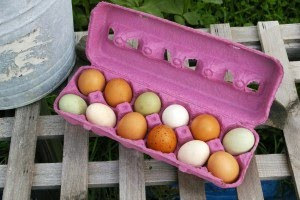
One of the favorite features of the Variety CSA are fresh eggs. No, those aren't dyed Easter eggs you see in the photo. Those are the natural colors. Nice browns, brown speckled, blue, green, tan, white. Who says eggs have to be white or brown?

Here at Carmel Lavender, I maintain one of the flocks that supplies the eggs for the Variety CSA. I keep a broad assortment of heritage hens that lay those beautifully colored eggs you see above.

This little lady, the black, grey, and white striped bird is one of those hens. She is a barred rock hen. She lays wonderful brown eggs. I also have Rhode Island Reds, Black Cornish, Buff Orpingtons, Auracanas, and a few other breeds. Each breed has different personalities. The black cornish like to have their backs scratched. The Rhode Island reds do too, to a lesser extend. The auracanas don't tend to like to be handled as much, and stay away from people. In fact, they tend to stay away from the other hens too. And the barred rocks have a nice temperament, but are not quite as forward as the black cornish hens are.

Here you can see two buff orpington roosters. No, they don't wait until sunrise to start crowing. Usually the noise begins around 3 or 4 in the morning. I actually like the sound. Sometimes I wake up partially, but it is kinda nice to feel the life around the farm, even while you sleep. They aren't too close to the house, or it might be more disturbing. I suppose roosters in close urban quarters would require enthusiastic neighbors!

The roosters protect the hens. That is their job. Any time you handle a hen, you can see a nervous rooster standing by, ready to step in if needed. They also keep the eggs fertile. I keep enough roosters to ensure fertile eggs.
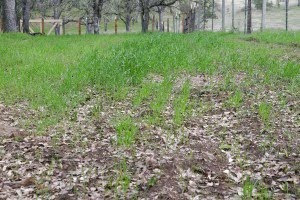
The chickens have a pretty diverse diet. I feed them the vegetarian kitchen scraps. They love that. It does mean a lot less for my compost heap though. But the chicken manure goes into the compost instead. I also give them a grain based chicken feed. And important in my farm plan is to let them forage on the grasses and wild plants. Here you can see a field I sowed with wheat a few months ago. The wheat is starting to get higher. When it is ready, I will let the chickens forage on this to supplement their diets.

These days, while the wheat isn't quite ready, I am bringing the chickens the grasses and weeds I pull from my home vegetable garden. I just load up the wheel barrow every morning, and then dump it into the tractor. The hens go to work! They can devour an entire load in one or two days. They sure seem to have fun picking through the pile to find the tastiest weeds!

I hope you enjoyed reading about the hens. And if you are interested in eggs, please go to the website at www.carmelvalleycoop.org and sign up for the Variety CSA! In addition to eggs, you enjoy fresh organic vegetables, lavender, essential oils, soaps, and delicious olive oil. Provided by Catalan Family Farms, Carmel Lavender, Larsen Family Farms, and Carmel Valley Olive Company.