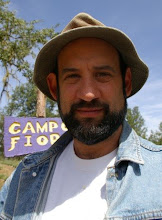
Friday, August 21, 2009

Harvest Interrupted by Swarm of Wild Bees

We interrupt the previously scheduled updates on oil harvest to bring you this special announcement. This evening as I was checking on the chickens one last time for the night, I hear a sound. A humming sound. I didn't have any equipment running, so I started across the yard to see what it was. About 100 yards away I found the source of the sound. A wild swarm of bees! Lucky day!

If you read my previous wild swarm post back in April, Catching a Swarm of Wild Bees, then you know about my previous attempt to capture a swarm earlier this year. Well in 2009, opportunity knocks...twice.

Okay, it was late, 7:30pm. The swarm is settling down quickly. and forming a tight little ball. I suited up, but now what?

Well, unlike in April, this swarm settled right near the house, on flat ground, and only about 6 feet up. I can reach that with a chair! So I grabed a box to put them in. I wasn't going to make the same mistake as last time, and drop them into a hive in the wrong spot!

Then I climbed up on a chair with my box and proceeded to knock the bees into it.

Since I could easily reach the branch, I quickly tried to brush some of the remaining bees into the box. Then I closed it up.

I waited for 10 minutes. A smaller ball formed again back up in the tree. But quite a few bees were now circling the box too. I think I had it. But I got another box and brused the remaining bees into the second box. Then I headed off to the new hive location.

I started five new hives this year. But one of the hives, the queen failed. I attempted to split another hive to restart the colony, but I was unsuccessful. But I happened to have a hive all set up with noone home! So I dumped the swarm into the new home.

Darkness was falling now. So I closed everything up and headed back to the house. I will check in the morning and see if the branch is clean and the hive is buzzin. I laughed a little to myself. Ten years ago a swarm paid us a visit. I ran into the house until they passed. Now I'm chasing them around the yard with boxes trying to make them my friends. How time changes us, no? You know, even if the hive is empty tomorrow morning, swarming bees mean colonies are growing. This is the way they reproduce. Maybe that means we are starting to see a comeback?

I sure hope so. I am happy to see the life flourish where I live.

Thursday, August 20, 2009

Oil Harvest Continues

The distillery runs all day. Here to the right, see the steamed lavender, depleted of color and the sweet smelling oil.

The gasket patches made a few days ago are still holding.

During the distillation, I monitor the oil production until the output tapers off, I decide when to call the run. Don't call it too early, or the oil yield is lower, don't call too late, or the scent is affected and the oil smells "burnt". As each distillation run wraps up, new lavender is brought freshly from the field to load the basket. And a new run is started.

Spent lavender is dumped from the basket. It will be hauled to a field to dry. The dry spent lavender straw is actually a fairly stiff straw.

Did you know that the Roman emperor Nero wrote about medicinal properties of Lavender 2000 years ago? Did you know that the Greek philosopher Diogenes recommended rubbing it on the feet so that the whole body would benefit? Read about the history of lavender through the ages here.

If you would like to purchase our Tassajara lavender essential oil, please contact us! We can arrange a delivery. It is a wonderful oil for relaxation, to scent the home or car, and many other healthy uses.

Wednesday, August 19, 2009

Oil Harvest Begins

The lavender oil harvest begins. It is time. Scythes swinging, the lavender buds are brought in from the field to the farm distillery where the precious oil will be extracted.

In the photo to the right, you can see the large basket being removed from the boiler upon completion of a distillation run. You can see the lavender scented steam raising from the top of the hot pot.

Lavender buds are placed into the basket and the basket into the boiler. Steam removes the sweet essential oils. As the steam flows into the essencier, the device that separates the oil from the distilled hydrosol, you can smell the lavender across the entire farm.

This is truly one of the most enjoyable times for a lavender farmer. Nothing beats the excitement of watching the golden lavender oil erupting from the condensed water and cascading into the bottle.

Tuesday, August 18, 2009

Preparing for Harvest

It's August. Time for the Lavender oil harvest. But before we can begin to harvest oil, we must make sure all of the preparations have been made. This means ensuring all of the harvest equipment is in good order and the harvest supplies are plentiful.

When harvesting bunches, it is important to have enough bunch ties. These are the ties I use to collect and hang bunches for drying. I use only natural twine. Here to the right is a sample. It consists of a big loop shown at the stop, which is tied with a slip knot. The bunches are inserted into this loop, then the end is cinched taught around the bunch. At the tip is a fixed loop so the bunches can be hung in the drying shed if necessary. I reuse the old bunch ties from last year. However, as the crop is growing, it is important to make new ties each year to ensure there is enough.

This year, inspecting the distillery, there were a couple of minor repairs needed before the harvest began. The most important repair was to the gasket that seals the basket in the boiler. It had separated at the seams and was allowing steam to come out through the cracks rather than being forced into the condenser.

I ordered a replacement gasket, but it did not arrive in time, therefore I needed to make some field repairs to get the distillery online for harvest. After a couple of attempts just to bond the seams together, it was clear that the surface area for the bond was not adequate for a strong joint. So I used the olde fashioned way: needle and thread. I sewed up the rubber seams using a hook needle and some strong thread.

There was still a gap however. This needed to be sealed with some high-temperature gasket material. In the photo to the right, you can see the finished repair.

In addition there were a few minor problems with the ignition system of the distillery. A metal deflector had broken during adjustment. After a few different modifications, I managed to get the ignitor to light the pilot automatically, and the unit was ready to begin distilling.

Scythe sharpened, all is ready for harvest!

Monday, August 17, 2009

Bonny Doon Fire Sunset in Tassajara

We had a beautiful sunset yesterday over the lavender. Blood red. An erie reminder of the Basin Complex fires last year in the Los Padres National Forest that spread ash over our entire farm for nearly 6 weeks, ruined our first culinary crop, and killed a number of my newer bee hives.

This time, the haze responsible for the beauty was not a nearby threat, but rather, it is coming form 80 miles to the north, the fire in the Santa Cruz mountains near Bonny Doon.

They too had a fire last year, and while we are quite safe here in Tassajara from this blaze, as I watched the brilliant red splendor, I couldn't help but think about the poor folks up north, and what they must be going though. Again. They grow lavender up there too. And the sky shows we are all connected, even when separated by almost a hundred miles.

I wish a speedy containment to the blaze up there, and my heart goes out to all of the residents that might be in harms way. May you all be safe.

Sunday, August 16, 2009

Lavender Bunch Harvest

A lot has happened on the farm since building the Ark. Chickens, lavender, and bees have consumed the hours of the days between my last post and today. Over the next few days, I attempt to make up for lost time, and recount some of the tasks that define daily life this summer.

In mid July, the angustifolia was ready for harvest. I grow angustifolia primarily as a culinary spice crop. It has a much deeper purple color that is beautiful on food, and in spice jars. It also has a very sophisticated scent and flavor. Much less camphorous than other lavender varieties. These qualities make it most suitable for food.

I work in a producer Co-op with several other farmers in the area. We share the responsibilities of managing distribution of production shares to Co-op subscribers. You can find more information about the Carmel Valley Co-op at our website at www.carmelvalleycoop.org. In July, it was my responsibility to provide fresh lavender bunches to include in the weekly distribution. I chose the Angustifolia, because the deep purple color made quite a striking bouquet.

In the photo, I am holding a bucket of Angustifolia from the bunch harvest. I love this time on the farm, because the lavender is most beautiful. It seems to pass so quickly. It is now August, and all of the lavender has now been cut. The green little "pillows" are still beautiful, but it is not the same. I guess the ephemeral nature of the seasons makes the magic.

If you are interested in culinary lavender, just let me know. You can contact me at http://www.carmellavender.com/contacts.htm and I can arrange a delivery. My culinary lavender will also soon be carried at Sun River in the Carmel Valley Village along with my Carmel Lavender essential oils and other lavender products.

Thursday, July 16, 2009

Building an Ark

Once upon a time, Humankind lost our way. History repeats.

The story goes that Man strayed so far from his intended path, that the biggest "do over" in history was necessary to right him. In one story, the Ark became the vessel that held the genetic material to repopulate the Earth. Hmmm....

It is hard to look at modern Agriculture and not wonder if such a monumental "do over" is again necessary to right that which has been defiled. I apologize for such harsh words, but our industrial food system is nothing less than an abomination of Nature. A complete redo is necessary to fix such a catastrophic mess the industrial machine has made of it. If you have not seen Food, Inc., then you need to. See the Food, Inc. website at http://www.foodincmovie.com/. Factory farming of everything from chickens to pigs to corn and soy have taken the soul out of the most spiritual connection a organism of this planet can experience, the act of eating. And now genetic tampering and patenting of the blueprints of life threaten to ruin the gift of life for future generations (Sign the petition to establish Monterey County as a GMO Free Zone at http://www.gmofreemontereycounty.org/).

On the foundation of such chaos, I have undertaken to begin rasing food. Though my primary crop has been lavender, I have been working with the home garden for a number of years. This year however, I am expanding to include chickens. Part of a journey to connect with food beyond gazing lifelessly at a carton of eggs in the sterile refrigerator of a corporate supermarket. To do this, you must know the soul of the organism that gives you life. You must respect it as a living being. You must care for it. Our modern corporate industrial agriculture is anything but respect for life. It is time to change that.

Here I hold a member of my new flock. She is a Barred Rock chicken. These are some of my favorites. They are very curious birds. I have other types, but these little gals are amongst my favorites. They approach me and offer only a token complaint when I pick them up. They are not as flighty as some of the other breeds of chicken. They don't bully their way to the feed dish. They seem to trust me, that I will ensure they get the food they need. They are not dominated by fear, and rather have a healthy curiosity for life.

When I thought about building a coop for my new chickens, symbolically it was a monumental departure. Leave the industrial food system behind, and begin a new food future. From the ground up. Though storm clouds may not fill the sky, they fill the future of food here on tiny planet Earth. The raindrops are each act of human folly. When we think we know better than nature. When I thought about building a new home for these gals, the image of the Ark popped into my mind.

To the right is a filmstrip of the construction. I started with a trailer base and an open bottom. The idea here is that the manure is able to fall directly onto the ground, and the Ark can be then moved to a new location. The manure can be disked into the soil upon which I can plant new food.

I constructed the walls from standard 2x4 studs. Then fastened them onto the open-bottom foundation. Though conceptually the design imitates the Ark of the legends, it has a practical purpose. The large central hallway allows for easy entrance without stuping. The lower sides can enclose and shelter the nesting boxes. Access panels allow egg gathering w/o entry into the coop (a definite plus, if you've ever been inside a chicken coop, you know why!).

I roofed th coup with corrugated metal panels, which are economical, and light weight. The siding is of inexpensive plywood, which will be painted on the outside for protection against the elements, but left natural on the inside.

A door is placed on each end for easy access. The top tower has wire mesh for ventilation. Cool air can be drawn through the open wire floor, and vent out through the top on hot days. For winter, I'm thinking I can construct shutters for the top openings to provide additional shelter and protection during cold months.

Inside, on each side, there is a battery of nesting boxes for the little ladies to do their business. Here you can see an interior view, the nesting boxes on each side, the open wire floor, the "windows" at the top, and the open door at the far end. Cozy?

Well, the new hens seem to think so. They watched me from the window of their temporary shelter as I worked. Today they keep me company, and I feed them. And tomorrow, they will give me fresh eggs to eat. They are looking forward to moving into their new Ark. Maybe a day or so more and the new home should be ready. I just need to finish the doors, and put a second layer of wire on the bottom to keep predators from reaching their little feet.

I'm as anxious as they are for them to move in!